Updated: July 2026
What is agentic AI, and why is it becoming one of the most important technology topics in 2026?
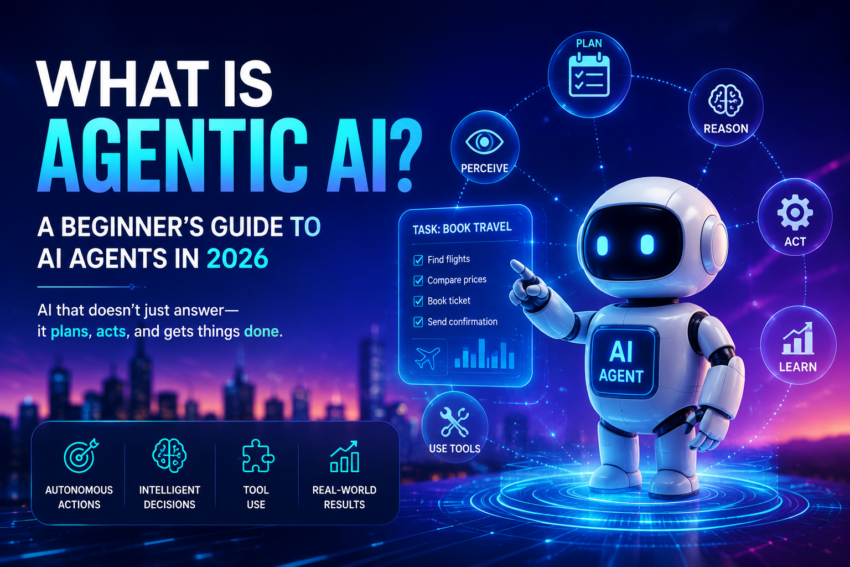
Agentic AI refers to artificial intelligence systems that can pursue goals, plan multiple steps, use tools, make decisions, and perform actions with limited human supervision. Unlike a basic chatbot that usually responds to one prompt at a time, an AI agent can continue working through a task, check the results, adjust its plan, and take further action.
For example, a traditional chatbot may draft a customer-service reply. An AI agent could read the customer’s request, check the order database, determine whether the customer qualifies for a refund, prepare the response, request approval when needed, and update the company’s records.
Google Cloud defines AI agents as software systems that use AI to pursue goals and complete tasks on behalf of users, using capabilities such as reasoning, planning, memory, observation, and action (Google Cloud, 2026).
This guide explains agentic AI in simple language, how it works, where it can be used, and the risks users and businesses should understand.
Table of Contents
Quick Answer: What Is Agentic AI?
Agentic AI is a form of artificial intelligence designed to act toward a goal rather than only generate an answer.
An agentic system can usually:
- Understand a goal
- Break the goal into smaller steps
- Select and use appropriate tools
- Collect information
- Make decisions
- Perform digital or physical actions
- Review the outcome
- Correct mistakes or change its plan
- Ask for human approval when necessary
An AI agent is not necessarily fully independent. Many practical systems operate inside strict permissions, approval rules, spending limits, security controls, and human-review processes.
Agentic AI vs. Traditional AI Chatbots
A chatbot and an AI agent may use similar language models, but they are designed differently.
| Feature | Traditional AI Chatbot | Agentic AI System |
|---|---|---|
| Main purpose | Answer questions or generate content | Complete goals and workflows |
| Interaction | Usually one prompt and one response | Multiple steps and repeated actions |
| Tool use | Limited or manually triggered | Selects and uses tools during the task |
| Planning | Usually short-term | Can create and revise multistep plans |
| Memory | Often limited to the conversation | May retain workflow or task context |
| Autonomy | Mainly reactive | Can act with limited supervision |
| Feedback loop | Usually stops after responding | Observes results and adjusts |
| Human approval | User directs most steps | Approval can be inserted at critical points |
Anthropic distinguishes between workflows, where tools and language models follow predefined code paths, and agents, where the model dynamically decides how to proceed and which tools to use (Anthropic, 2024).
This distinction is important. Not every automation needs to be an autonomous agent. A simple workflow may be safer, faster, cheaper, and easier to maintain when the task is predictable.
What is agentic AI and how do AI agents work
Most agentic AI systems combine a language model with instructions, tools, memory, permissions, and an execution loop.
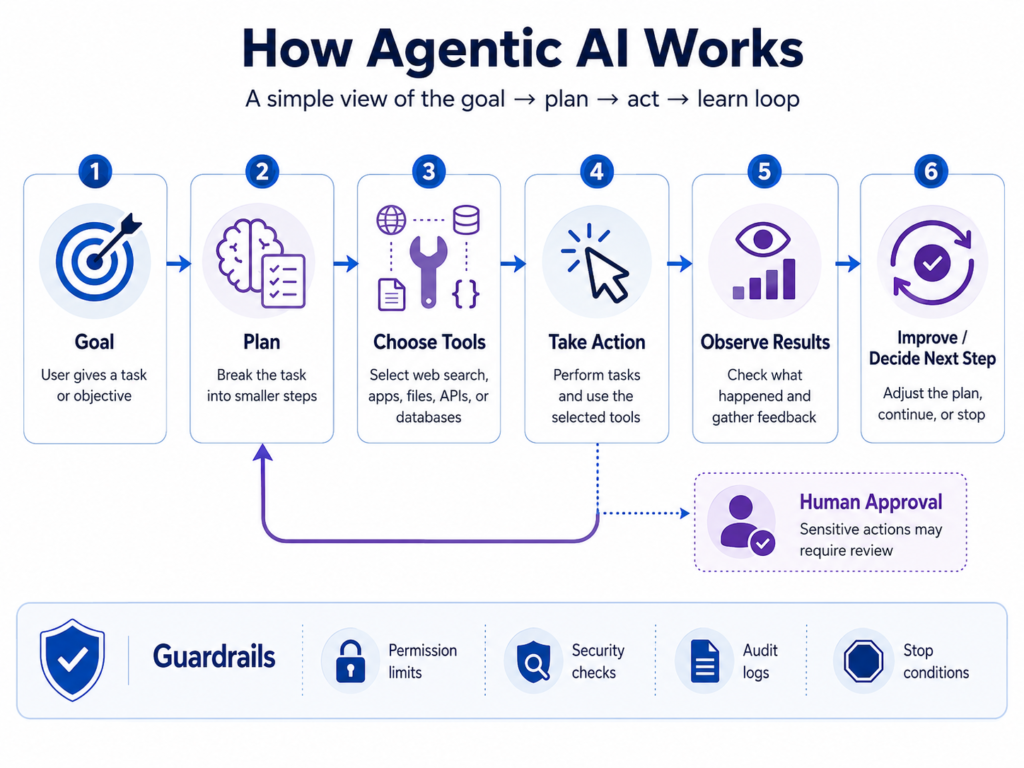
1. The User Provides a Goal
The process begins with an objective rather than a single narrow command.
Example:
Research five competing accounting applications, compare their pricing and features, and prepare a recommendation for a small business.
The agent must interpret what success means before it begins.
2. The Agent Creates a Plan
The system breaks the goal into smaller tasks, such as:
- Identify relevant products.
- Visit official product pages.
- collect pricing and feature information.
- Compare the options.
- Check for missing information.
- Prepare a recommendation.
Planning helps the system manage a complex objective that cannot be completed in one response.
3. The Agent Selects Tools
Tools allow an agent to interact with information and external systems.
These tools may include:
- Web search
- Company databases
- Calendars
- Spreadsheets
- Customer relationship management software
- Payment systems
- Code execution
- File storage
- Business applications
- Computer-use interfaces
OpenAI explains that tools extend an agent’s capabilities through application programming interfaces and, in some cases, computer-use systems that interact with websites or applications through their interfaces (OpenAI, n.d.).
4. The Agent Takes Action
The agent performs one or more actions, such as retrieving data, updating a record, creating a document, scheduling a meeting, or sending a draft for approval.
This ability to act is one of the main differences between agentic AI and ordinary text generation.
5. The Agent Observes the Result
After each action, the system evaluates what happened.
It may ask:
- Did the search return useful information?
- Was the database update successful?
- Did the customer qualify for the requested action?
- Is more information needed?
- Did the tool return an error?
- Does a human need to approve the next step?
6. The Agent Adjusts Its Plan
If the first approach fails, the agent can revise its strategy.
For example, if a pricing page is unavailable, it may search an official help center, review documentation, or flag the missing information instead of inventing an answer.
7. The Agent Stops or Escalates
A responsible agent should have clear stopping conditions. It may stop when:
- The task is complete
- A maximum number of steps has been reached
- A required tool fails
- The confidence level is too low
- The action is too sensitive
- Human approval is required
OpenAI describes this repeated plan–act–observe process as an execution loop that continues until an exit condition is reached (OpenAI, n.d.).
Core Components of an AI Agent
A practical AI agent normally contains several connected components.
AI Model
The model interprets instructions, reasons about the task, generates plans, and decides what to do next.
Instructions
Instructions define the agent’s role, goals, limits, tone, procedures, and prohibited actions.
Tools
Tools connect the agent to external data and applications.
Memory and Context
Memory helps the system retain important information across steps. This may include conversation history, completed actions, customer preferences, or previous tool results.
Guardrails
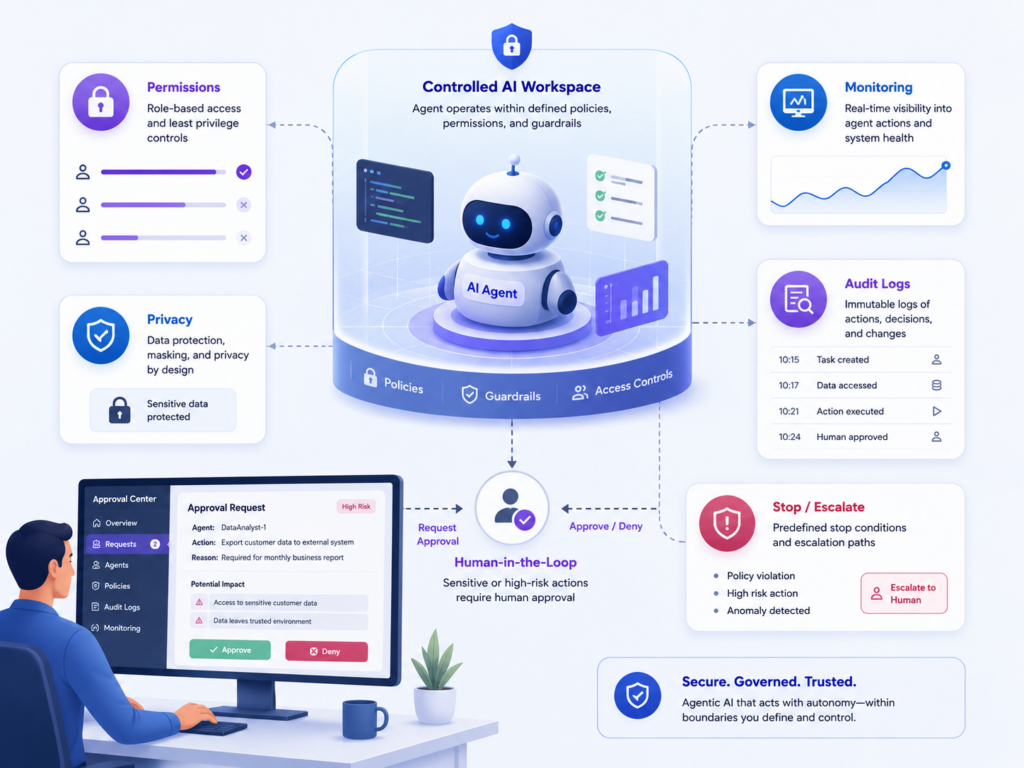
Guardrails restrict what the agent can access or do. Examples include:
- Requiring approval before sending money
- Preventing access to private folders
- Limiting the number of emails sent
- Blocking dangerous commands
- Restricting changes to production software
- Recording actions for later review
Human Oversight
Human oversight is essential for sensitive, expensive, irreversible, or high-impact decisions. Anthropic recommends agentic systems particularly for tasks with clear success criteria, useful feedback loops, and meaningful human supervision (Anthropic, 2024).
Real-World Examples of Agentic AI
Customer Support Agents
A customer-service agent could identify the customer, retrieve order information, answer questions, process an approved return, and update the support ticket.
Research Agents
A research agent could search multiple sources, organize findings, identify disagreements, create a comparison table, and prepare a cited summary.
Coding Agents
A coding agent could inspect a software project, identify a bug, modify files, run tests, review errors, and revise the code.
Sales and CRM Agents
A sales agent could qualify incoming leads, update CRM records, draft personalized follow-ups, schedule meetings, and notify a salesperson when human attention is needed.
Marketing Agents
A marketing agent could research keywords, create an editorial plan, draft content, prepare social-media variations, and monitor performance.
Administrative Agents
An administrative agent could review calendars, propose meeting times, prepare agendas, organize documents, and create follow-up tasks.
Financial and Operational Agents
Businesses may use carefully controlled agents to reconcile invoices, detect missing information, prepare financial reports, or route requests to the correct department.
High-risk actions should not be fully automated without controls, audit logs, identity verification, and appropriate human authorization.
What Is Agentic AI? Key Benefits
Automating Multistep Work
Agentic AI can handle tasks that require several connected actions rather than one isolated answer.
Reducing Repetitive Work
Agents may reduce manual copying, searching, categorizing, scheduling, and data-entry tasks.
Working Across Multiple Applications
An agent can connect tools that employees currently operate separately.
Adapting to Changing Conditions
Unlike a fixed automation rule, an agent may adjust its plan when information is missing or the environment changes.
Supporting Employees
The best use of agentic AI is often to assist people rather than remove them from the process. An agent can prepare work, surface exceptions, and allow the human to make the final decision.
Operating Continuously
Some agents can monitor systems or queues and respond when defined conditions occur.
Risks and Limitations of Agentic AI
Agentic AI creates greater value partly because it has greater access and autonomy. Those same qualities also create risk.
Incorrect Decisions
An agent may misunderstand the goal, rely on false information, or select the wrong action.
Tool Misuse
An agent with excessive permissions could delete files, expose information, send inappropriate messages, or modify important systems.
Prompt Injection
Malicious instructions hidden inside websites, documents, emails, or tool results may attempt to redirect an agent away from the user’s goal.
Privacy and Data Exposure
Agents may process sensitive personal, business, financial, or health information. Access should follow the principle of least privilege.
Memory Poisoning
Incorrect or malicious information stored in an agent’s memory can influence later decisions.
Cascading Errors
In multi-agent systems, one agent’s mistake may be passed to other agents and amplified across a workflow.
Lack of Accountability
Businesses need to know who approved an agent, what it accessed, what actions it performed, and who is responsible when something goes wrong.
The OWASP Top 10 for Agentic Applications identifies major risks affecting systems that plan, act, and make decisions across complex workflows (OWASP Foundation, 2025).
Why Agent Safety and Standards Matter in 2026
Agentic AI has moved beyond a software trend and become a standards, security, and governance issue.
In February 2026, the U.S. National Institute of Standards and Technology launched its AI Agent Standards Initiative to support secure, interoperable agents and research agent identity, authentication, and security evaluation (National Institute of Standards and Technology, 2026).
In July 2026, the International Telecommunication Union announced a global focus group addressing trust, identity, accountability, interoperability, and meaningful human control for autonomous AI agents (International Telecommunication Union, 2026).
Google DeepMind has also proposed a defense-in-depth approach that combines model alignment, monitoring, restricted permissions, threat modeling, and intervention systems for increasingly capable agents (Flynn & Shah, 2026).
The European Commission states that AI agents are covered by the existing definitions in the EU AI Act. Depending on their use, agents may also be subject to high-risk requirements and transparency obligations from August 2, 2026 (European Commission, 2026).
These developments show that the future of agentic AI depends not only on smarter models, but also on identity, authorization, monitoring, interoperability, and human control.
How Businesses Should Start Using AI Agents
Businesses should begin with a narrow, measurable task rather than an autonomous system with broad access.
A practical starting process is:
- Choose one repetitive or time-consuming workflow.
- Define the expected result.
- Identify the data and tools required.
- Limit the agent’s permissions.
- Require approval for sensitive actions.
- Test the agent in a controlled environment.
- Record every important action.
- Measure accuracy, time saved, errors, and cost.
- Expand only after the system performs reliably.
Anthropic recommends starting with the simplest possible solution and increasing complexity only when necessary because agentic systems may trade higher cost and latency for flexibility and performance (Anthropic, 2024).
OpenAI similarly recommends beginning with a capable baseline, evaluating performance, defining tools clearly, and moving to multi-agent designs only when a single agent is no longer sufficient (OpenAI, n.d.).
What Is Agentic AI Compared With AGI?
No.
Agentic AI describes systems that can plan and act toward goals. These systems may still be narrow, limited, and dependent on existing models and tools.
Artificial general intelligence, or AGI, generally refers to a hypothetical system with broad human-level or greater competence across many intellectual domains.
An AI agent can be useful and autonomous within one workflow without possessing general intelligence.
Will AI Agents Replace Employees?
To understand the employment question, it helps to return to the central issue: what is agentic AI designed to do?
AI agents may automate parts of some jobs, especially repetitive digital tasks. However, most business processes also involve judgment, accountability, relationships, negotiation, physical work, and responsibility.
A more realistic near-term model is human–agent collaboration:
- The agent gathers information.
- The agent prepares routine work.
- The agent recommends an action.
- The human checks exceptions.
- The human approves high-impact decisions.
- The organization remains accountable.
The effect will vary by industry, job function, regulation, and the quality of implementation.
Frequently Asked Questions
What is agentic AI in simple terms?
Agentic AI is AI that can plan and take actions to achieve a goal, rather than only responding with text.
What is an AI agent?
An AI agent is a software system that uses an AI model, instructions, tools, context, and an action loop to complete tasks on behalf of a user or organization.
Are ChatGPT, Claude, and Gemini AI agents?
They are AI assistants that can support agentic features and workflows, but whether a specific use qualifies as an agent depends on its access to tools, ability to plan, level of autonomy, and ability to perform actions.
Can AI agents use websites and applications?
Yes. Depending on their configuration, agents can use APIs, databases, browsers, software interfaces, files, and connected business applications.
Are AI agents safe?
They can be useful, but they are not automatically safe. Security depends on permission limits, tool design, monitoring, testing, audit logs, human approval, and the sensitivity of the task.
Do small businesses need AI agents?
Not every small business needs an autonomous agent. A simple chatbot, template, or automation may solve the problem more safely and cheaply. Agents are most useful when a workflow requires decisions, multiple steps, tool use, and adaptation.
What Is Agentic AI? Final Thoughts
Agentic AI represents a shift from AI that mainly answers to AI that can plan and act.
The technology can help users research information, automate workflows, support customers, write and test code, organize business operations, and work across multiple applications. However, greater autonomy also creates greater responsibility.
The most useful AI agents in 2026 are not necessarily the most independent. They are the systems that complete clearly defined tasks while operating within strong permissions, monitoring, security controls, and human oversight.
Businesses should start small, measure results, and give agents only the access they genuinely need.
References
Anthropic. (2024, December 19). Building effective agents.
European Commission. (2026). How are AI agents addressed within the AI Act? AI Act Service Desk.
Flynn, F., & Shah, R. (2026, June 18). Securing the future of AI agents. Google DeepMind.
Google Cloud. (2026, April 2). What are AI agents? Definition, examples, and types.
International Telecommunication Union. (2026, July 9). ITU launches global standards initiative to build trust in AI behaviour and identity.
National Institute of Standards and Technology. (2026, February 17). AI Agent Standards Initiative.
OpenAI. (n.d.). A practical guide to building agents.
OWASP Foundation. (2025, December 9). OWASP Top 10 for Agentic Applications for 2026.